
If you’ve been dazzled by the Nintendo Switch OLED’s gorgeous screen, the arrival of the Switch 2 is a dream come true. Nintendo officially unveiled the Switch 2 on April 2, 2025, igniting excitement among fans of the hybrid console. This could be the perfect gift for yourself or family for the holidays, just relax and play some games solo, or with friends and family. In this review, I’ll share that initial “wow” factor and then dive into a thorough, professional look at Nintendo’s newest handheld.
Design and Build
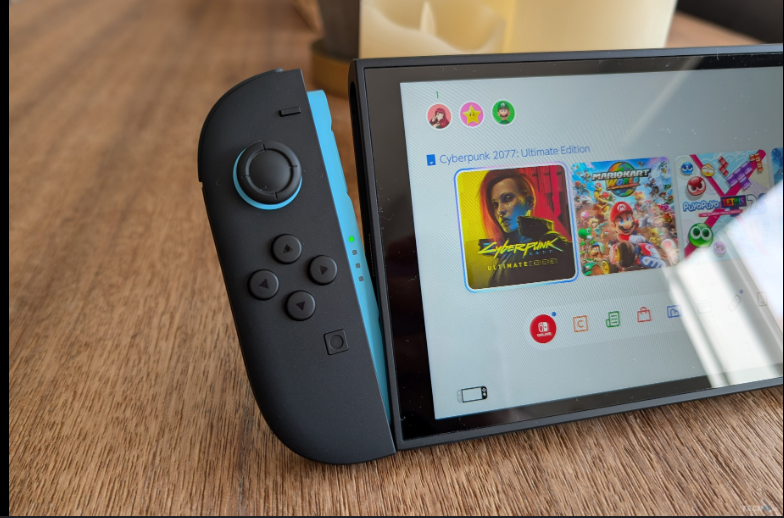
At first glance, the Switch 2 feels familiar but subtly refined. It’s noticeably larger than the original Switch or Switch OLED – about 10.7 inches wide (with Joy-Con attached) and a bit heavier – yet Nintendo has managed to keep the thickness nearly the same. This larger size accommodates a bigger screen (7.9 inches vs 7.0 on the OLED model) without making the device feel bulky. Reviewers note that the weight distribution feels balanced and comfortable. The chassis uses the same sturdy plastic as before, but with minor refinements like a new full-width kickstand.
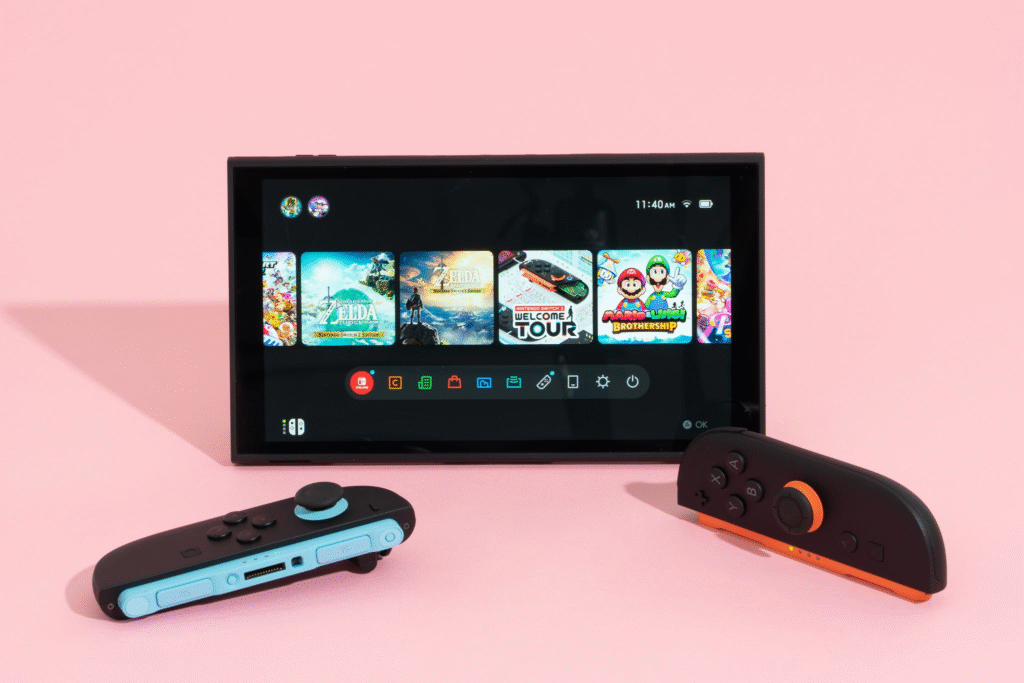
One of the best improvements is the Joy-Con attachment system. The Switch 2 still uses the iconic rail system, but now with strong magnets that produce a reassuring click when you slide the Joy-Con 2 controllers on or off. Unlike the flimsy rails of the past, the new Joy-Con snap firmly into place and stay put without wobble. The Joy-Con 2 themselves are slightly larger and more ergonomic, with smoother triggers and sturdier sticks. Nintendo also redesigned the SL/SR buttons on the detached Joy-Con to be chunkier, making them easier to press.
The overall build quality feels sleek and well-made. USB-C ports appear on both the top (for accessories/power) and bottom (for the dock/charging), and there’s a 3.5mm headphone jack on the top as usual. The dock’s construction (two USB-A ports on the side, one HDMI, one LAN) is functional but a bit on the plain side. In short, the design is smartly updated: familiar but noticeably refined, with magnetic Joy-Con, better grips, and thoughtful touches in all the right places.
Display Quality
The Switch 2’s screen is a standout, even though it’s not OLED. Nintendo upgraded to a 7.9-inch wide-gamut LCD panel at 1920×1080 resolution. This means every game is now full HD in handheld mode – a big jump from the Switch’s 720p or the OLED’s 1080p on 7 inches. More importantly, the LCD itself is very high quality. It supports HDR10 for richer colors and deeper contrast, and has variable refresh (VRR) up to 120 Hz for smoother motion. In practice, reviewers say the colors are bright and punchy and the contrast is excellent for an LCD. The screen may not hit OLED’s inky black levels, but it easily outclasses the original Switch’s display.
Another bonus: Nintendo added VRR up to 120Hz, which helps eliminate screen tearing during fast action. Everyday gaming on the Switch 2’s screen feels crisp and fluid. First-party ports and new titles alike look noticeably sharper. For example, Mario Kart World (a Switch 2 launch title) looked “clean and crisp,” with none of the blur of older models. In summary, the Switch 2’s LCD is excellent – bigger, brighter, and smoother than anything Nintendo has done handheld before.
Hardware and Performance Specs
Under the hood, the Switch 2 is a major step up. At its heart is a custom NVIDIA Tegra “T239” SoC, built on advanced Ampere architecture. This eight-core ARM CPU is paired with 12 GB of LPDDR5X RAM and a GPU with 1,536 CUDA cores. In docked mode, the GPU can reach about 3.07 TFLOPS, and around 1.72 TFLOPS handheld – roughly 10× the graphics performance of the original Switch. Importantly, the Switch 2 chip includes dedicated ray-tracing cores and Tensor cores for AI features. Those enable real-time ray tracing effects and NVIDIA’s DLSS upscaling, which lets games render at a lower internal resolution and upscale smoothly. The result: visually rich games with high frame rates even in handheld mode.
The Switch 2 can output up to 4K at 60 fps in TV mode and run games at 1080p up to 120 Hz in handheld mode. Storage-wise, the console has 256 GB of fast UFS 3.1 built-in storage, a big jump from the 32–64 GB of old models. It also supports microSD Express cards up to 2 TB. Load times are much quicker, and games feel snappier overall. In sum: the Switch 2’s hardware is roughly a mid-gen console like a PS4 Pro or Xbox Series S in terms of raw power, but optimized for handheld use.
New Features Compared to Previous Models
The Joy-Con 2 controllers have stronger magnets, larger grips, and new internal features: for example, the right Joy-Con now includes an “IR motion” / mouse sensor mode. The Joy-Con 2 also boast HD Rumble 2.0 and have a quoted 20-hour battery life. Nintendo even updated the Pro Controller with a built-in headphone jack.
Online and social features are much expanded. A new “Game Chat” feature lets friends set up voice (and video-avatar) chat sessions outside of any game. Another clever addition is “GameShare,” which allows you to stream your game to another Switch device for couch co-op. Everyday quality-of-life tweaks abound, too: menus and the eShop open much faster and feel smoother. Built-in speakers are louder and richer. The docking system has also been upgraded with HDMI 2.1 and a wired Ethernet port.
Battery Life
All that power comes at a cost: battery life is shorter than before. Officially, Nintendo quotes about 2–6.5 hours of play on a full charge. In practice, expect around 2–3 hours on demanding titles, and 5–6 hours on lighter games. The 5220 mAh battery simply can’t last as long when the console is running triple-A games. A portable USB-C battery pack is recommended if you want to game on the go all day. On the plus side, the unit charges in about 3 hours via its USB-C port.
Game Compatibility (Backward Compatibility)
Nintendo has made the Switch 2 largely backward compatible with the original Switch’s software library. Both physical cartridges and digital Switch games can run on Switch 2. Most popular titles work out of the box, and many receive graphical upgrades thanks to the extra horsepower. However, a few older games that rely on the original Joy-Con’s IR sensor or accessories may require the older controllers. Overall, backward compatibility is a strong point.
Online Experience and Ecosystem
Nintendo’s online ecosystem gets an upgrade, too. The Nintendo Switch Online service continues, offering cloud saves and the classic games library, but now with a redesigned interface. The big new additions are the social features described earlier: Game Chat and Game Share. Many launch games are designed around digital distribution, with family sharing options to lend digital games for two weeks at a time. Overall, the online and ecosystem changes aren’t radically different, but they feel more modern and integrated.
Comparison to Switch OLED and Steam Deck
Versus Switch OLED: The Switch 2 has a larger screen, higher frame rates, and more power, but shorter battery life. The OLED still wins on perfect blacks, but the Switch 2 is clearly more future-proof.
Versus Steam Deck: The Steam Deck offers more raw PC flexibility and repairability, while the Switch 2 is lighter, more portable, and delivers Nintendo exclusives with polished handheld design. The Deck is better for PC gamers; the Switch 2 is better for Nintendo fans. In specific cases, like optimized titles using DLSS, the Switch 2 can even outperform the Deck visually, but overall the Deck remains more versatile.
Who Should Buy It
The Nintendo Switch 2 is aimed at Nintendo fans and handheld gamers who want the latest tech. It’s perfect for those who want to play upcoming titles like Metroid Prime 4 or The Legend of Zelda: Echoes at their best. Families will appreciate local multiplayer and docking to the TV. At $449.99 USD (or $499.99 with Mario Kart World), it’s a premium device best suited for those who will make use of the extra power. Note: regional pricing may vary.
Final Verdict
The Nintendo Switch 2 is the ultimate evolution of Nintendo’s hybrid console concept. It’s far more powerful than its predecessor, with a gorgeous new 1080p HDR screen, magnetic Joy-Con rails, and console-like visuals on the go. Battery life is its Achilles’ heel, but that’s a trade-off for the big performance jump. Most importantly, the Switch 2 retains the “Nintendo feel” that made the original so magical, while adding modern comforts like voice chat, GameShare, and faster menus.
Bottom line: The Switch 2 is an impressive, satisfying upgrade. It’s not a radical reinvention, but it significantly raises the bar. For anyone looking forward to the next wave of Nintendo games, it’s the perfect machine — ready for the future.