

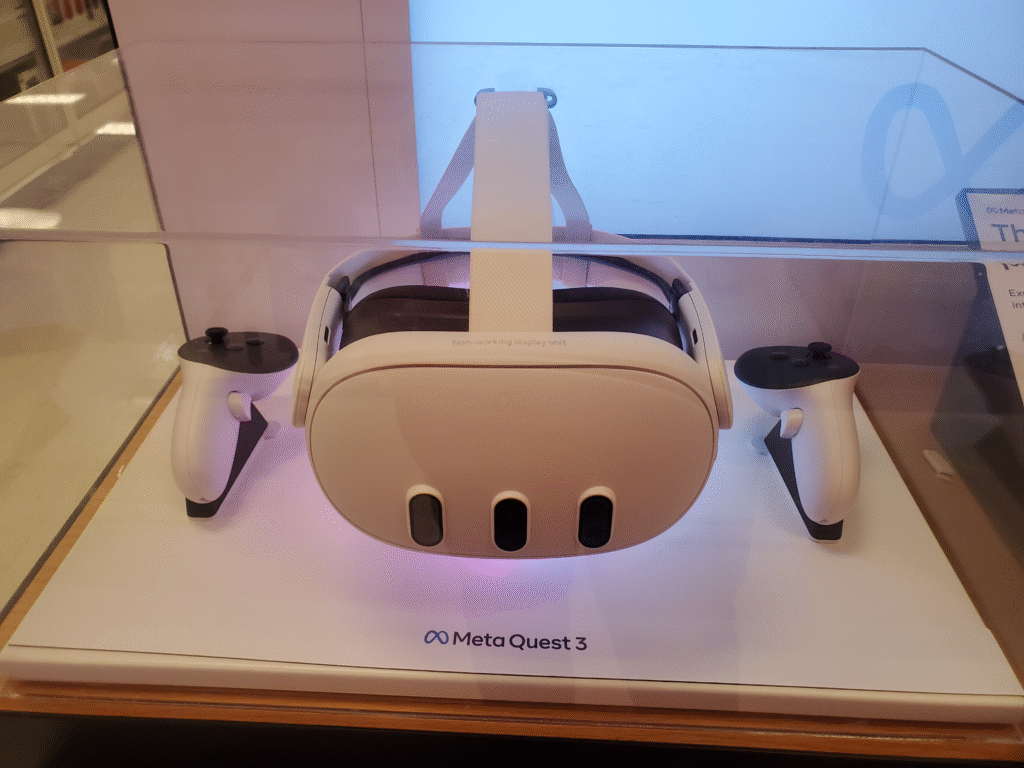
Virtual reality has been steadily evolving, and in 2023 Meta (formerly Oculus) took a bold step with the Meta Quest 3, a standalone VR headset that pushes the boundaries of what you can do without a connected PC or console. More than just a spec bump over its predecessor the Quest 2, the Quest 3 brings next-generation performance, mixed-reality features, better visuals, and redesigned controllers. But is it worth it in 2026, especially as VR technology faces increasing competition and shifting company priorities? Let’s find out.
🎨 Design & Comfort
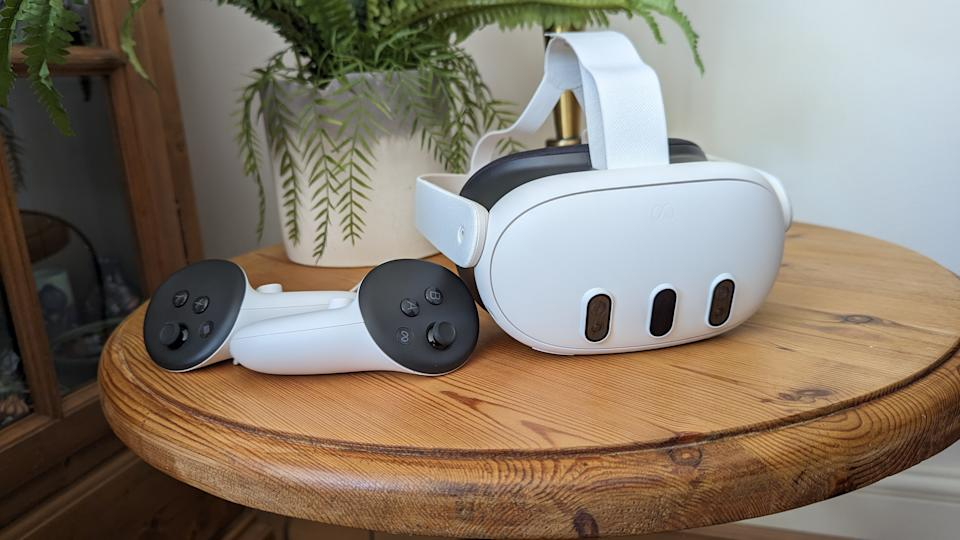
The Quest 3’s design marks a clear evolution from the Quest 2. While it retains a similar silhouette, the headset is slimmer thanks to pancake optics — thinner lenses that reduce bulk and improve clarity.
At about 515g, it’s slightly heavier than the Quest 2, but improved ergonomics and an IPD adjustment wheel make it more comfortable for a wider range of users, including those with glasses.
The new Touch Plus controllers ditch the tracking rings, offering a streamlined design with precise 6DoF tracking directly from the headset cameras.
🖼️ Display & Visual Quality
With 2064×2208 pixels per eye, visuals are noticeably sharper than the Quest 2. Text is easier to read, details are clearer, and environments feel more immersive.
The Snapdragon XR2 Gen 2 chip roughly doubles GPU performance compared to the Quest 2, enabling smoother frame rates, better lighting, and richer environments. Combined with refresh rates up to 120Hz, the Quest 3 delivers a significant leap in visual fidelity.
🎮 Performance & Mixed Reality
Beyond VR, the Quest 3 pushes mixed reality into the mainstream. Full-color passthrough lets you interact with your real surroundings while overlaying virtual elements — from playing games on your living room floor to placing digital objects in your environment.
While MR content is still developing, the potential is clear. Traditional VR gameplay remains strong, with smooth performance across demanding titles and support for PC VR streaming via Oculus Link or Air Link.
🔋 Battery Life & Real-World Use
Battery life averages 2–2.5 hours, similar to the Quest 2 despite the more powerful hardware. Graphically intense games and MR sessions drain faster, while casual apps last longer. Charging takes about two hours, and many users rely on strap-mounted battery packs for extended play.
🎧 Audio & Connectivity
Built-in 3D speakers deliver surprisingly rich audio, though Bluetooth audio suffers from latency — especially noticeable in rhythm or timing-based games. Wired or low-latency options remain preferable.
Connectivity includes Wi-Fi 6E, Bluetooth, and USB-C for charging or PC tethering, giving flexibility for both standalone and PC VR experiences.
🕹️ Games & Content Library
The Quest ecosystem remains one of the strongest selling points, with a wide range of fitness apps, social VR, narrative adventures, and puzzle games. While Meta’s shifting priorities raise questions about future exclusives, third-party developers continue to support the platform with fresh content.
🆚 Compared to Competitors
Against premium rivals like Apple Vision Pro, the Quest 3 offers similar mixed reality features at a fraction of the cost. Many users prefer its controller-based interaction over gesture-only systems.
Compared to tethered PC VR headsets or newer hybrid devices in 2026, the Quest 3 doesn’t match the absolute cutting edge but strikes a balance between performance, convenience, and affordability.
💵 Pricing & Value
At launch, the Quest 3 started at $499 for the 128GB model, though that version has largely been replaced by the 512GB model at the same price. A higher-capacity version originally retailed around $649.
It’s more expensive than the Quest 2, but the upgrades in visuals, performance, and mixed reality make it a solid value for those seeking a polished standalone VR experience.
⚠️ Pros & Cons Summary
👍 Pros
- Sharper visuals and higher resolution than Quest 2
- Mixed reality passthrough expands possibilities
- Strong performance with Snapdragon XR2 Gen 2
- Comfortable design with redesigned controllers
- Large content library and standalone convenience
👎 Cons
- Limited battery life (~2–2.5 hours)
- Mixed reality content still sparse
- Bluetooth audio latency issues
- Higher price may deter casual buyers
📌 Verdict: Is the Meta Quest 3 Worth It?
The Meta Quest 3 remains one of the most compelling standalone VR headsets available. It delivers sharper visuals, mixed reality features, stronger performance, and ergonomic improvements — making it a worthwhile upgrade for Quest 2 owners and an excellent entry point for newcomers.
It isn’t flawless: battery life, MR content availability, and audio limitations are drawbacks. But if you want a comfortable, capable headset with a huge library of games and experiences — all without needing a PC or console — the Meta Quest 3 is absolutely worth considering.