



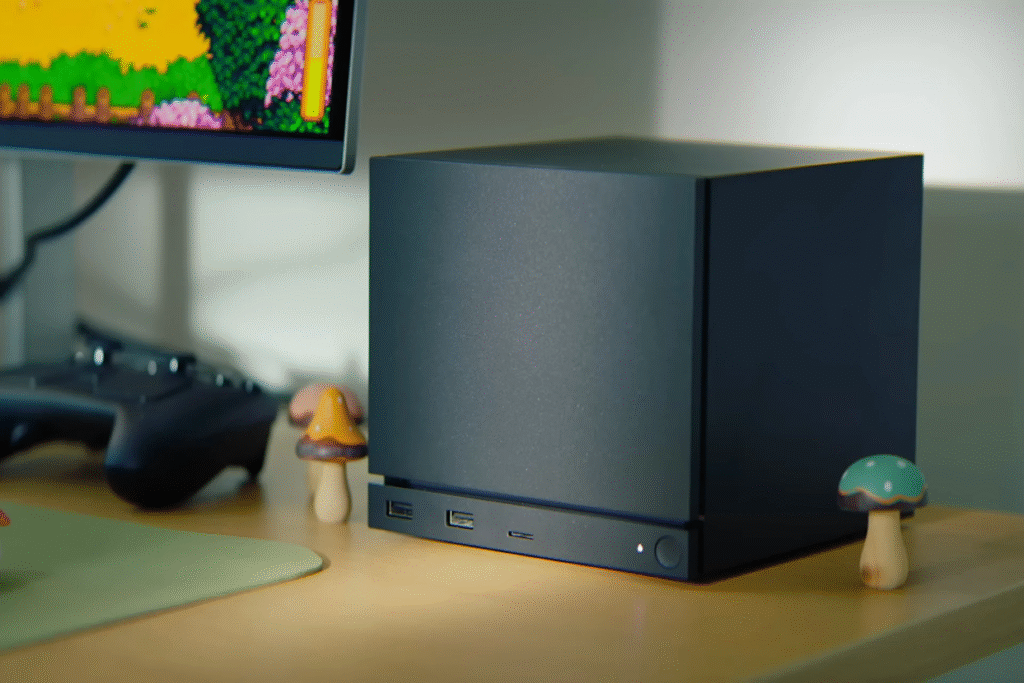
When we thought the console wars were over, along comes Valve with a new challenger: the Steam Machine. First teased as part of Valve’s renewed hardware lineup alongside the Steam Controller and Steam Frame VR headset, the Steam Machine promises to bring true PC gaming power to the living room — without the complexity of building your own desktop or the compromises of a traditional console.
Valve’s hardware journey has been intriguing — from the Steam Machine experiments of the 2010s to the runaway success of the Steam Deck in the 2020s — and now to an exciting fusion of PC and console gaming that could blur the lines in early 2026.
Let’s break down everything we know so far about the upcoming Steam Machine: release window, specs, performance expectations, price speculation, accessories, and how it stacks up against today’s gaming devices.
🎮 What Is the New Steam Machine?
The Steam Machine that Valve is building for 2026 isn’t a console in the traditional sense — it’s essentially a compact SteamOS-powered gaming PC designed for the living room. Valve confirmed the new iteration in late 2025, making this the first time in years they’re directly entering the hardware race beyond the Steam Deck handheld.
Unlike the original Steam Machines from 2014–2015 — which were developed by third parties and struggled because of poor software support — this version is designed entirely by Valve with modern SteamOS, broad game compatibility via Proton, and hardware that aims to perform well at higher resolutions.
You can already find the Steam Machine’s page on Steam’s official hardware sale portal, where players are encouraged to wishlist it for updates (no exact launch date yet, just “early 2026”).
🗓️ Expected Release Window: Early 2026
Valve hasn’t given an exact day, but the consensus across industry reports is that the Steam Machine will arrive in Q1 2026 — between January and March. That aligns with Valve’s historical release patterns (for example, the Steam Deck launched in February after a similar early announcement).
Pre-orders haven’t been announced yet, but Valve’s Steam Store listing already lets you wishlist the Steam Machine for notifications about pricing and availability.
🛠️ Specifications: PC Power in a Cube
Details continue to firm up, but various reputable sources agree on the likely core hardware components:
🔹 CPU & GPU
- Semi-custom AMD Zen 4 CPU — 6 cores / 12 threads @ up to ~4.8GHz
- Semi-custom AMD RDNA 3 GPU with ~28 compute units and 8GB GDDR6 VRAM, with a sustained performance profile totalling ~110W TDP.
Valve claims the Steam Machine will deliver “over six times the horsepower of a Steam Deck,” targeting a gaming experience that can handle 4K gaming at 60 FPS with FSR (AMD’s FidelityFX Super Resolution) and even competitive high-refresh scenarios.
🔹 Memory & Storage
- 16GB DDR5 RAM
- Storage options: 512GB NVMe SSD or 2TB NVMe SSD, both expandable via microSD.
This gives it headroom for not just Steam games but a wide variety of PC titles — including those that may not have native Linux ports, thanks to Proton compatibility.
🔹 Operating System
- SteamOS 3 (Arch-based Linux with KDE Plasma) focused on gaming and TV/console usage.
SteamOS continues Valve’s strategy of making Linux gaming viable and compatible with a massive library via Proton, and many Steam Deck verified titles will run on Steam Machine with minimal fuss.
🔹 Connectivity & Ports
- HDMI 2.0 (up to 4K @ 120Hz)
- DisplayPort 1.4 (up to 4K @ 240Hz or 8K @ 60Hz)
- Gigabit Ethernet
- Multiple USB-A and USB-C ports
- Wi-Fi 6E and Bluetooth 5.3
- Built-in 2.4 GHz wireless adapter for Steam Controller connectivity
All this in a compact cube form factor — roughly a 15x15x15 cm footprint that’s easy to place beside your TV or entertainment center.
💡 Performance Expectations: Console vs PC
Valve has said explicitly that the Steam Machine will not be subsidized like traditional consoles, meaning it won’t be priced below cost to attract buyers — it will be priced more like a comparable PC. This signals Valve’s intention to compete with PCs rather than undercut consoles.
Analysts speculate prices could range between $699 and $999 depending on configuration (512GB vs 2TB and whether accessories are bundled), with some even placing it closer to higher-end console tiers if PC-like performance is considered.
That price range could put the Steam Machine in direct competition with devices like the PlayStation 5 Pro or the Xbox Series X, but with advantages many consoles lack — namely direct access to the enormous Steam game library, PC-style upgrades, and Linux-based flexibility.
🎮 Game Compatibility & Features
✔ Massive Steam Library
One of Steam Machine’s biggest strengths is its seamless access to the Steam ecosystem — including cloud saves, friends lists, remote play, and all games you already own on Steam that are verified or compatible via Proton.
✔ Cross-Device Play
Like the Steam Deck, expect to stream games between your existing PC and Steam Machine, share saves, and even use existing Steam Controller configurations.
✔ Controller & Accessories
Valve is also reviving or updating the Steam Controller, ensuring native support and ergonomic compatibility with the Steam Machine, plus other peripherals.
Third-party accessories like themed skins (including Portal Companion Cube editions) are already generating buzz, hinting at a vibrant modding and personalization scene around the hardware.
🏡 Into the Living Room: Console-Like Simplicity, PC-Like Power
Valve is positioning the Steam Machine as the best of both worlds: a console-like plug-and-play experience powered by a full PC-grade architecture and PC gaming ecosystem.
🎯 Key Advantages
- Easy setup: Connect to your TV, login to Steam, start playing
- Access to tens of thousands of Steam titles
- True PC performance and expandability (storage + microSD)
- TV-optimized UI with SteamOS 3 and Proton for game compatibility
This positions Steam Machine as more than a box; it’s a bridge between traditional console simplicity and PC gaming openness.
🧠 Why Valve Is Betting on the Steam Machine Now
Valve’s original Steam Machine platform in the mid-2010s struggled due to fragmented OEM partnerships and limited software support. The learning from that era and the success of the Steam Deck has given Valve:
- Proven SteamOS can work at scale
- Built credibility with mainstream gamers
- Matured Proton compatibility for non-Linux games
These lessons appear to have culminated in the new Steam Machine — designed not just as a niche PC, but a viable competitor to consoles while retaining PC flexibility.
📊 What This Means for Gamers & the Competition
🎮 For Gamers
If Valve delivers Steam Machine with its projected specs, it could:
- Let gamers play PC-level games in the living room more easily
- Eliminate the need for expensive desktop rigs for some players
- Support a hybrid library (PC + console time, streamed or local)
⚔️ For the Console Market
The Steam Machine could challenge the traditional console model by:
- Offering a non-subsidized, high-performance alternative
- Emphasizing game library ownership vs subscriptions
- Bridging handheld and living room play seamlessly
Industry watchers note that because Valve intends to price this like a PC, it won’t be a loss-leader like typical consoles, which could change how gamers and developers perceive mainstream gaming hardware.
🧐 Final Thoughts: Valve’s Bold Comeback
Valve’s Steam Machine is shaping up to be one of 2026’s most exciting gaming hardware releases. It’s not a nostalgia play or retro box; instead, it’s a modern reimagining of PC gaming for the living room, backed by a massive library and deep ecosystem.
Whether you’re a long-time Steam Deck owner, a console gamer curious about PC accessibility, or someone who just wants the best possible gaming experience on your TV without building a PC, the Steam Machine could be a game-changer — if Valve gets the pricing and performance balance right.
Wishlist it now on Steam and stay updated as we approach its expected early 2026 launch!